

What happens when our commitment to kindness is tested?
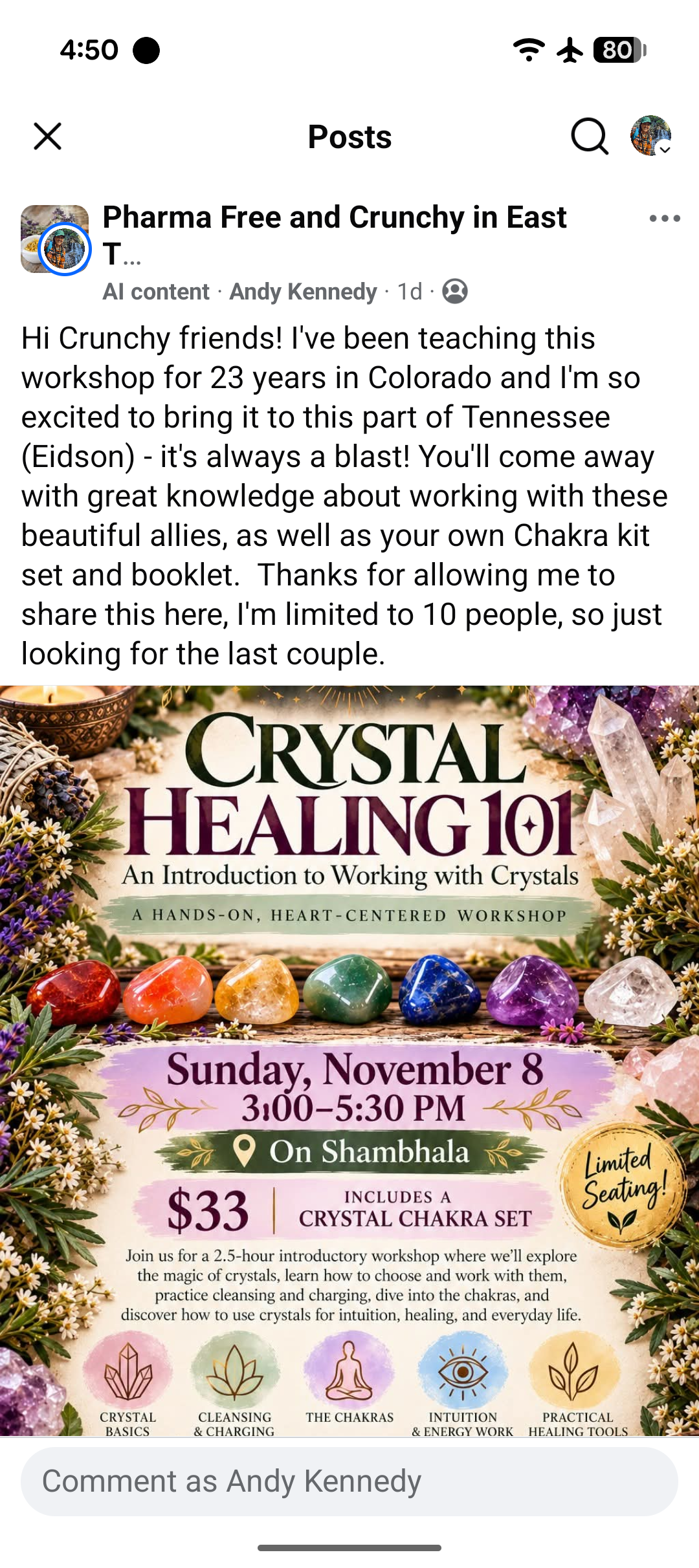
A few days ago, I shared an invitation to a crystal workshop I’ve taught for 23 years. I was excited to bring it to my new home in East Tennessee and hoped to find a few more curious souls to join us.
Instead, some of the responses described the practice as witchcraft and the occult, accompanied by warnings to stay away.
I won’t name the group or the people who commented. Their identities aren’t the point. I’m not interested in turning anyone into a villain.
I eventually took the post down. And then I sat with the expegrience.
Not because a few strangers get to determine what I teach or how I live. They don’t. But because moments like these invite us to look more closely at the world we’re creating together—and the world we say we want.

When the darkness feels bigger than the light
It’s challenging to feel like an island of love in an ocean of hostility.
When we offer something meaningful and receive judgment in return, our first instinct may be to defend ourselves. We want to explain, correct the misunderstanding, or point out the contradiction of preaching love while expressing contempt for someone else’s beliefs.
And sometimes speaking up is exactly the right thing to do.
But I noticed something else happening in myself. I caught myself hating the hate. I felt the pull to judge the people who were judging me.
And I had a choice.
I could keep feeding that energy, or I could acknowledge the sting, learn what I could from the experience, and return to the work I actually want to do.
I chose to step away.
Not because I was afraid to stand up for myself. Not because I suddenly agreed with the criticism. And certainly not because I intend to stop teaching something I love.
I stepped away because I didn’t want a handful of strangers to determine where my attention went next.
I don’t want to spend my life fighting darkness. I want to spend it cultivating light.
The mirror, without the self-blame
One of the spiritual questions I return to is this: If I see something in the world that troubles me, what is my relationship to that same energy?
When I encounter judgment, do I respond by judging the person doing the judging? When I encounter hostility, do I allow it to make me hostile?
It’s worthwhile to examine our own reactions. But self-reflection can become another trap if we start believing that witnessing unkindness means we somehow created it.
It doesn’t.
Being hurt by someone’s words doesn’t mean we’ve failed at our spiritual practice. Feeling angry doesn’t mean we’re no longer compassionate. We are human beings, not perfectly enlightened observers floating above the messiness of life.
The practice isn’t to never feel anger or hurt.
It’s to notice those feelings before they decide our next move.
I can recognize unkindness without becoming unkind in return. I can disagree without needing to humiliate someone. I can protect my peace without pretending that nothing happened.
And I can remember that a person is more complex than a single comment, even when that comment is hurtful.
Compassion doesn’t require us to approve of everything someone does. Sometimes it means speaking up. Sometimes it means setting a boundary. Sometimes it means walking away.
The wisdom lies in learning which response serves the moment.
Where do we direct our light?
I could have written a post calling out the people who upset me. I could have invited others to weigh in and constructed the perfect argument for why kindness matters.
But I found myself asking a different question.
What do I actually want to give my energy to?
Do I want to keep returning to the place where I felt misunderstood, hoping to make myself understood? Or do I want to invest in the relationships, experiences, and communities that reflect the world I’m trying to create?
I want to keep teaching. I want to cultivate Shambhala. I want to create spaces where people can explore, question, learn, and grow without fear of being ridiculed for their curiosity.
I want to build something beautiful.
And sometimes, the most empowering response is to stop trying to persuade people who have already decided what they think of you and turn toward the people who are ready to meet you with openness.
We cannot control how others respond to our light. We can, however, choose where we shine it.
We can choose not to make every disagreement a battle. We can choose not to carry every hurt into the next conversation. We can choose to return to our purpose.
And we can laugh. Sometimes a great, ridiculous, full-bodied laugh is exactly what we need to remember that not every human drama deserves to become our life’s work.
Perhaps we can let some of that hostility deflate like a Gonzo-crazed balloon, wobbling around the room before collapsing into a heap of rubber.
Not everything deserves a battle.
A question worth carrying
I don’t believe love means pretending darkness isn’t there. I don’t believe kindness requires us to tolerate cruelty or abandon our boundaries.
But I do believe we have a choice about what we carry forward.
When we encounter judgment, we can choose discernment. When we encounter anger, we can practice steadiness. When we encounter division, we can remain connected to our own humanity.
We won’t always get it right. I certainly won’t.
But I want to keep trying.
I want to be the kind of person who can encounter something difficult without automatically passing that difficulty along to someone else.
I want to find love in the darkest places—not because we must make darkness beautiful, but because we refuse to let it determine what we become.
What would change in your life if you stopped asking how to win every battle and started asking what you actually want to cultivate?
Perhaps that’s where the work begins.
❤️