
It’s that time of year.
The weather gets cooler. The days get shorter. We start spending more time indoors. Somebody at the grocery store coughs directly into the air three feet in front of you. 😂
And suddenly everyone is talking about “cold and flu season.”
I don’t believe in living in fear of germs.
I do believe in supporting your body before you need it.
Over the years, I’ve developed a handful of simple seasonal practices that have become part of our household rhythm. Some are herbal. Some are nutritional. Some are just good old-fashioned common sense.
And some are things I learned from people who knew a thing or two about keeping people well.
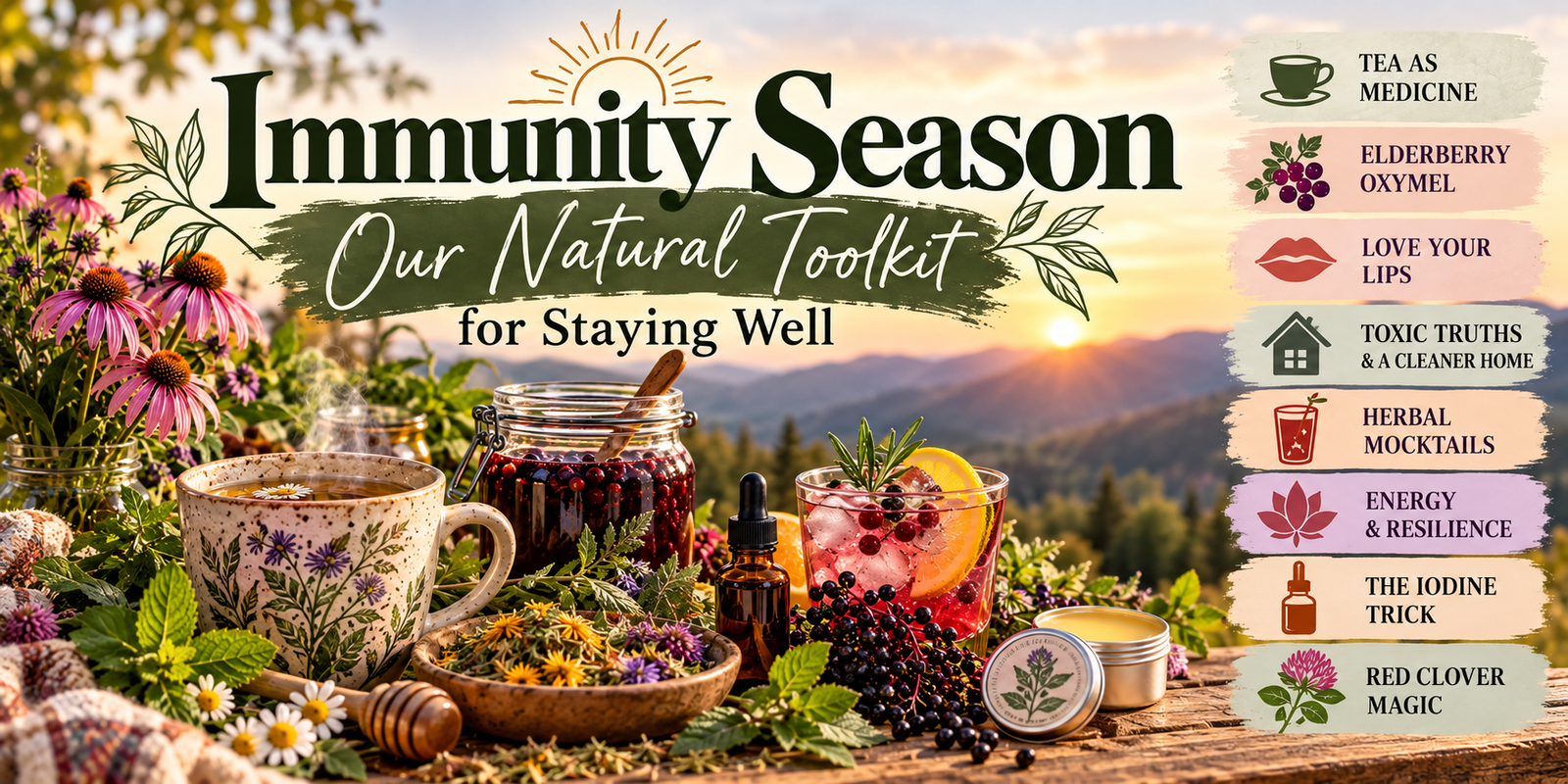
So here’s our Immunity Season Toolkit.
1. Make tea a daily ritual
This is probably the simplest place to start.
I don’t wait until I feel sick to reach for herbs.
I like making herbal tea part of the daily rhythm of the season.
Our Shambhala Tea is one of my favorites because I formulated it as an everyday restorative blend—not a “take this when you’re sick” tea.
It combines herbs like astragalus, hawthorn, lemon balm, peppermint, calendula, and wild violet. The idea is to support the whole system: resilience, digestion, circulation, nervous-system balance and overall vitality.
Because here’s something I’ve learned:
Your immune system doesn’t operate in isolation.
Sleep, stress, digestion, nutrition, movement, hydration and nervous-system health all matter.
Tea is an easy way to make some of that support a ritual instead of another thing on your to-do list.
And if you’re curious about herbs as medicine, check out my video Tea as Medicine.
I also have a video on Herbs for Gut Health, because your gut and your immune system are having a much more intimate conversation than most people realize.
2. Elderberry season!
This is one of my favorite seasonal remedies to make.
Elderberries have a long history of traditional use, and I love turning them into something that’s both medicinal and delicious.
One of my favorite preparations is Elderberry Oxymel—elderberry infused with vinegar and honey.
It’s tart. It’s sweet. It’s potent. And honestly?
It makes taking your herbs feel a lot less like taking medicine.
I’m going to make a new video showing exactly how I make ours, because apparently I have a habit of making things in real life and then forgetting to put them on YouTube. 🤦🏼♀️
[LINK TO ELDERBERRY OXYMEL SHORT]
This is also a great example of why I love learning to make your own medicine.
You don’t have to buy a cabinet full of expensive supplements.
You can learn a few plants.
Learn a few preparations.
And start building your own household apothecary.
That’s sovereignty.
3. Don’t forget the dry-season stuff
Immunity season isn’t only about respiratory bugs.
Cold weather and indoor heat can absolutely wreak havoc on your skin and lips.
So while I’m stocking up on tea and herbs, I’m also pulling out the Love Your Lips lip balm.
Because cracked lips are annoying enough without trying to drink your tea while your mouth feels like sandpaper.
Small thing?
Yes.
But this is how I think about wellness in general:
It’s not one giant intervention. It’s dozens of tiny supports that make your body easier to live in.
4. Pay attention to your environment
This is where my Toxic Truths work comes in.
Because if you’re trying to support your body’s resilience while simultaneously surrounding yourself with fragrances, harsh cleaners, pesticides, questionable personal-care ingredients and other unnecessary exposures…
…well, let’s just say I’d rather remove some of the load than keep adding more things to compensate for it.
That’s the philosophy behind Toxic Truths.
I’m not interested in making you terrified of everything in your house.
I’m interested in helping you look at what you’re using, decide what actually matters, and start replacing the unnecessary stuff.
Less toxic load. More resilience.
5. Hydration doesn’t have to be boring
One of my favorite tricks is making hydration something I actually want to drink.
Enter the mocktail.
Sparkling water. Herbs. Citrus. Berries. A splash of something delicious.
You can make a beautiful little ritual out of hydration without turning it into another health chore.
And honestly, this is one of the reasons I love herbalism so much.
It doesn’t have to be:
“Here is your disgusting green liquid. Drink it because it’s good for you.”
It can be beautiful.
It can taste good.
It can be social.
It can be fun.
Wellness doesn’t have to feel like punishment.
6. Protect your energy, too
This one doesn’t get talked about enough.
When the days get shorter, I pay attention to energy.
Not just “How many supplements can I take to get more energy?”
I’m talking about the bigger picture.
Am I sleeping?
Am I eating enough protein?
Am I getting outside?
Am I moving?
Am I overloaded?
Am I spending too much time staring at a screen?
Am I giving my body enough actual nourishment to do what I’m asking it to do?
Because sometimes what we call “low immunity” is really a body that’s exhausted.
And sometimes the most radical immune support is…
go to bed.
Eat something nourishing.
Drink some water.
Take a walk.
Put the damn phone down.
You know I’m right.
7. And then there’s the iodine story…
This one came to me from our favorite neighbor, “St. Ann,” who worked as a nurse in a hospital during COVID.
She told me that the nurses on her ward had a particular practice during that period.
Before, during and after their shifts, they would use a diluted iodine spray in the nose and throat as part of their personal routine.
Her observation?
None of the nurses in her group got COVID.
Now, I want to be very clear about how I’m sharing this.
That’s her experience, not proof that iodine prevents COVID or other respiratory infections.
There has been research into povidone-iodine and its ability to inactivate microorganisms, including SARS-CoV-2 in laboratory settings, and some clinical research has looked at its use in the mouth and nose. But that is not the same thing as proving that using iodine this way prevents infection. The FDA has also taken action against products making COVID-prevention claims for intranasal/oral povidone-iodine.
So I’m not telling you:
“Do this and you won’t get sick.”
I’m telling you:
This is a fascinating story I was told by a nurse who lived through that experience—and it made me curious enough to investigate further.
And that, frankly, is how I approach a lot of health information.
I don’t need to blindly believe everything I’m told.
And I don’t need to blindly dismiss it either.
I can ask:
What’s the story?
What’s the evidence?
What’s actually known?
What’s still unknown?
And what is appropriate and safe for me?
That’s a much more sovereign way to approach your health.
And yes…
I think the iodine story deserves its own deep dive, because there is enough here to talk about without cramming it into an immunity roundup.
So consider this a teaser.
8. And finally… Red Clover Magic
Because apparently I can’t write an herbal post without sneaking in one more plant. 😂
Red clover is one of those plants that deserves far more attention than it gets.
I’ve got a whole little love affair with this plant, and I made a short about it here:
[LINK TO RED CLOVER MAGIC SHORT]
And this is really the bigger point.
The more I learn about plants, the less I think of them as isolated “remedies.”
I think of them as allies.
Different plants have different personalities, constituents, traditional uses and ways of supporting the body.
The goal isn’t to memorize 500 herbs.
It’s to start developing a relationship with a handful of plants you understand really well.
My Immunity Season Philosophy
So if you want the condensed version of what we actually do around here?
🌿 Tea regularly.
🍇 Elderberry when it makes sense.
💧 Stay hydrated.
🥗 Eat real, nourishing food.
😴 Protect your sleep.
🌱 Reduce unnecessary chemical exposure.
💋 Take care of the dry-season stuff.
☀️ Get outside and move your body.
🧠 Manage your stress and your energy.
🔍 Stay curious about health information instead of blindly accepting—or rejecting—it.
And most importantly:
Don’t wait until you’re sick to start supporting your body.
That’s the piece I think we often miss.
Health isn’t something we “fix” when something goes wrong.
It’s something we practice.
A little bit every day.
A cup of tea.
A handful of berries.
A walk outside.
A good night’s sleep.
A cleaner home.
A nourishing meal.
A little less screen time.
A little more sunlight.
A little more attention to what your body is actually asking for.
That’s the kind of health sovereignty I’m interested in.
Not perfection.
Not fear.
Not a cabinet full of pills.
Just learning how to become a better steward of the body you’ve been given.
And then?
Making it delicious. 🌿
Note: This post is for educational purposes and reflects my personal practices and experiences. Herbal products and natural remedies are not substitutes for medical care. If you are sick, at high risk for complications, pregnant, taking medications, or considering using iodine or another antiseptic in the nose or throat, talk with an appropriately qualified healthcare professional and use products only as directed.